Four Architectural Eras in a Single Courtyard
Standing in the center of the Blois courtyard offers an immediate architectural panorama spanning four distinct French periods:
- Medieval Gothic (13th Century): The Great Hall of the States-General, France's oldest surviving non-religious Gothic civil hall.
- Flamboyant Gothic / Early Renaissance (1498–1501): The red-brick and white-limestone Louis XII wing, featuring an equestrian statue of the king above the portal.
- High Renaissance (1515–1524): The François I wing, housing the world-famous octagonal exterior spiral staircase decorated with royal salamanders.
- Classical French (1635–1638): The austere, symmetrical limestone wing designed by François Mansart for Gaston d'Orléans, brother of Louis XIII.
The Assassination of the Duke of Guise (1588)
Blois was the stage for one of the most ruthless political executions in European royal history. In December 1588, during the height of the French Wars of Religion, King Henri III summoned his charismatic and overly ambitious rival, Henri de Lorraine, Duke of Guise (leader of the Catholic League), to his private council chamber on the second floor.
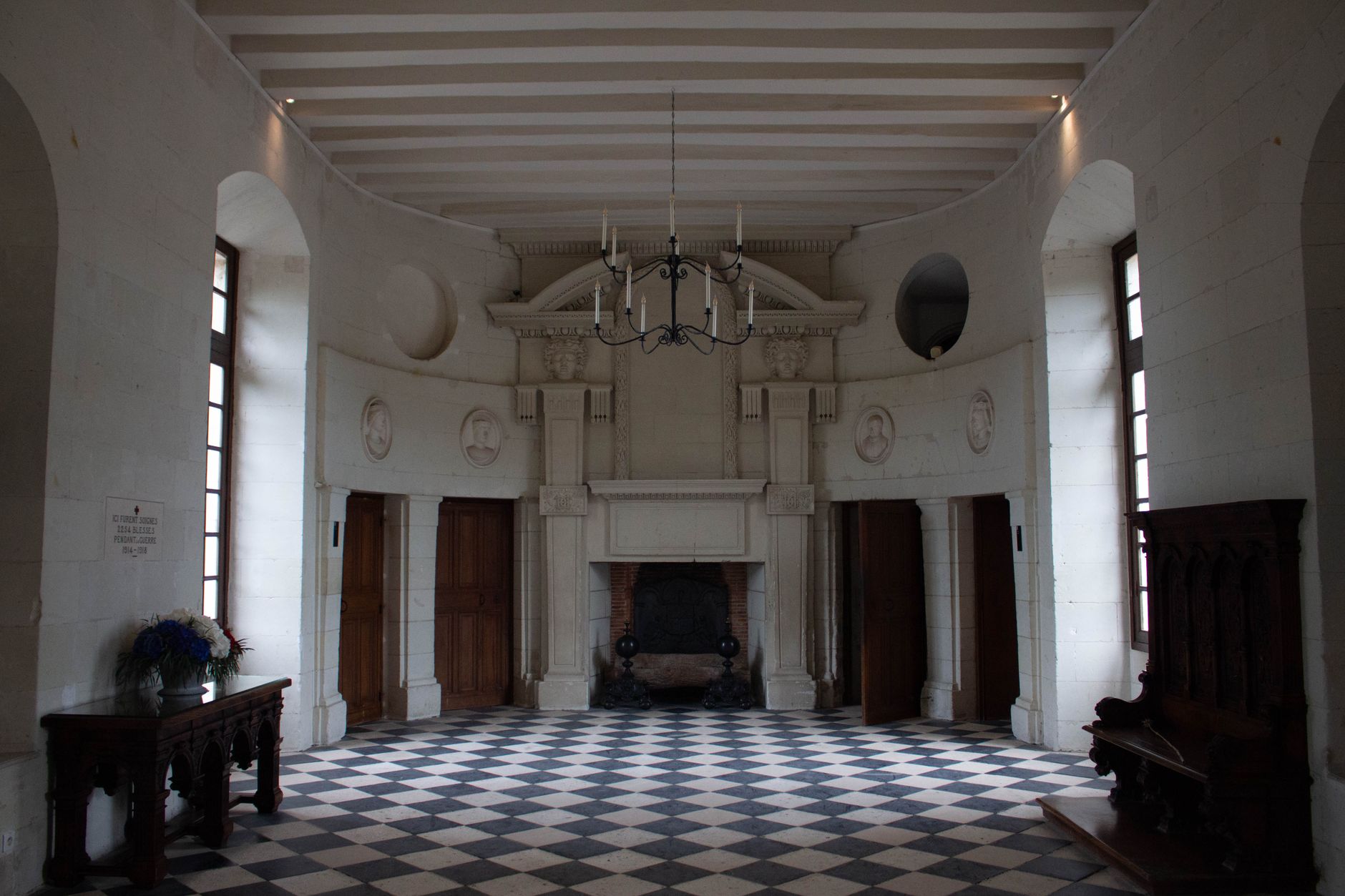
As Guise entered the royal bedchamber, the King's personal bodyguards—known as the "Forty-Five"—ambushed and stabbed him repeatedly. The following day, Guise's brother, the Cardinal of Lorraine, was executed in the castle dungeons. Today, visitors can stand in the exact chamber where the assassination took place, complete with period floor tiling and authentic Renaissance armoires.
Exploring Blois as Part of a Regional Pass
Make the most of your stay in Blois by grouping your admissions. Local train connections link Blois directly to Amboise and Tours in under twenty minutes.
Catherine de' Medici's Secret Studiolo and Hidden Wall Cabinets
On the second floor of the François I wing sits the private study (studiolo) of Catherine de' Medici, Queen of France and mother to three successive monarchs (Francis II, Charles IX, and Henri III). This intimate Renaissance room is clad with 237 exquisitely carved Italianate wooden wall panels depicting botanical motifs, grotesque masks, and royal monograms.
Nineteenth-century romantic novelists popularized the myth that four secret hidden panels, operated by concealed floor pedals, were used by Catherine to store lethal poisons. While modern archival research confirms these concealed cupboards actually stored rare books, prayer missals, state treaties, and the royal family's private jewel collection, the room remains one of the most evocative Renaissance private chambers surviving intact in Europe.
The Hour-by-Hour Timeline of the Guise Murder
The assassination of Henri, Duke of Guise, on December 23, 1588, was calculated with surgical precision by King Henri III. Blois was gripped by freezing rain as the States-General gathered in the Great Hall below. At 07:00, Henri III positioned eight members of his loyal gascon bodyguard, known as 'The Forty-Five', in his bedchamber armed with concealed daggers.
When the Duke arrived at 08:30 wearing a gray satin doublet, he was informed the King wished to consult him in his private cabinet. As Guise lifted the heavy tapestry drape leading to the room, the bodyguards struck. Despite suffering dozens of wounds, the physically imposing Duke fought desperately, dragging his assailants across the floor before collapsing at the foot of the royal bed. Henri III emerged from his hiding place behind the drapes and famously exclaimed: 'Mon Dieu, qu'il est grand! Il paraît encore plus grand mort que vivant' (My God, he is tall! He looks even bigger dead than alive). The following day, the Duke's body was cremated in the castle fireplaces to prevent his bones becoming holy relics for the Catholic League.
The Musée des Beaux-Arts in the Louis XII Wing
The first floor of the red-brick Louis XII wing houses the Blois Museum of Fine Arts, established in 1869. The collection comprises over 35,000 works of art, highlighted by 16th- to 19th-century French and Flemish masters. Noteworthy masterpieces include portraits by François Clouet, historic salon paintings by Jean-Auguste-Dominique Ingres, and expansive mythological tapestries woven at the Royal Gobelins Manufactory depicting the conquests of Alexander the Great.
The 360-Degree Evening Sound and Light Spectacle
From April to September, the central courtyard of Blois transforms at night into a dazzling open-air theater. Using high-definition architectural mapping projections and surround sound, the four historic wings become towering projection screens recounting the royal court's triumphs, loves, and tragedies in luminous color. English audio headsets are provided free of charge with admission (€11.50 for the show alone, or €21.00 combined with a daytime castle visit).